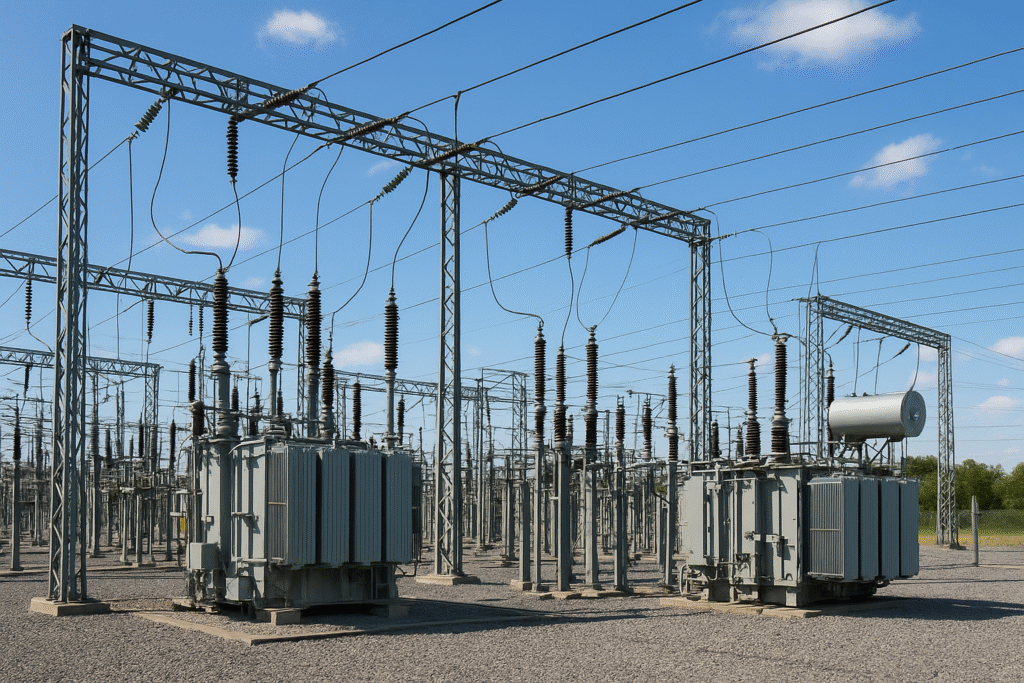
Understanding Key Concepts in Substation Design
Before diving deep into the technicalities of substation design, it’s important to familiarize ourselves with some fundamental terms that form the backbone of protection and operation in power systems.
🔹 Non-Directional Overcurrent Protection
This protection mechanism operates solely based on the magnitude of current, without considering its phase angle. It ensures quick action during abnormal current flow but does not account for direction.
🔹 Directional Overcurrent Protection
Unlike non-directional protection, this system considers both the magnitude of current and its phase angle with respect to voltage at the relay point. This adds an extra layer of reliability, particularly in interconnected networks.
🔹 Overcurrent Relays
An overcurrent relay responds to AC current and is defined by two key settings:
- Time Setting – Determines how long the relay takes to operate.
- Plug Setting – Defines the current level at which the relay activates.

🔹 Reclosure in Electrical Power Systems
In many cases, faults like flashovers are temporary. If the arc path is interrupted long enough to deionize, power can be safely restored. This process—called reclosure—allows the system to automatically attempt re-energization.
- In low-voltage systems, up to three reclosures are typically allowed before the breaker locks out.
- In extra-high-voltage systems, due to the potential for severe damage and stability risks, usually only one reclosure is permitted.
👉 Takeaway: A strong understanding of these protection mechanisms is essential before moving into advanced substation design concepts. These basics not only enhance system reliability but also play a critical role in maintaining grid stability.
You can watch video https://youtu.be/r7PDtZ3AJAQ?si=xjhmPUxI_iEhHf1U